Showing posts with label Berber. Show all posts

Wednesday, July 21, 2010

Moroccan meals a delight for the senses


This week, Jennifer Harley of MEDA's financial services area reflects on her recent experiences traveling in Morocco.

Every meal in Morocco is a delight for the senses. It is a pleasure to enjoy the spread of eclectic cultural influences: couscous from the Berbers, the Moorish mix of nuts, fruits and meats, and the unmistakable oils of the Mediterranean coast and the Arabic peninsula.

The markets in Casablanca are teeming with delectable treasures from all corners of the country and the scent of cinnamon and cumin is seemingly in the air no matter where you go. There’s also something very exotic about stalls filled with spices, both ground and whole, and about the sight of large jars of saffron worth more, per ounce, than gold.

During my visit, though, I discovered that food in Morocco is not only delicious, but also fun to eat. Lunch is the biggest meal of the day in Morocco, a time for families to be together away from the heat and strong mid-day sunshine.

Dining is always communal, and in many small cities and towns, no cutlery is offered. Most of the time, I used my hands and the fresh crusty white bread to dip into the large bowl of spiced stew in the middle of the table. The bread also acts as a vehicle for the homemade olives and cold beet salads.

Customarily, guests in a Moroccan home are offered far more food than they can possibly eat as a show of hospitality, which can be a little overwhelming at first – but luckily, most homes have dining rooms complete with well-cushioned benches, just in case you doze off satiated.

Monday, April 19, 2010

Morocco's Berbers balance children's needs


This week's guest blogger, Fouzia Mharzi of MEDA MAROC, talks about how the nomadic Berber (Amazigh) population of the mountainous Middle Atlas region of Morocco view schooling.

"During the French colonization of Morocco, our grandparents tell us, a new law required countrymen of the Middle Atlas area to send their children to school. This meant rural populations would be deprived of a traditional labor force – their large families. At a young age – 6 or 7 – children began to help their parents as shepherds or in other farming works. Families saw their children's future in the fields.

"But slowly, poor families began to invest in their children's education, hoping that one day, they’d become a state employee – primary school teacher, forest warden – who could provide for themselves, their parents and their extended family.

"Now, with a much higher cost of living, primary school teachers and forest wardens can no longer provide a decent life for their children, even in today's much smaller families.

"Middle class families who can more easily afford to invest in their children's education are only able to provide enough schooling to ensure their children attain basic financial independence from their parents when they become adults.

"In poor families, children are often kept at home to help with farming. Girls either stay at home to do the house work or are sent into town to contribute to the daily basic expenses by working in service. Such is the case for of thousands of young maids under age 15 who work for rich families in pitiful conditions."

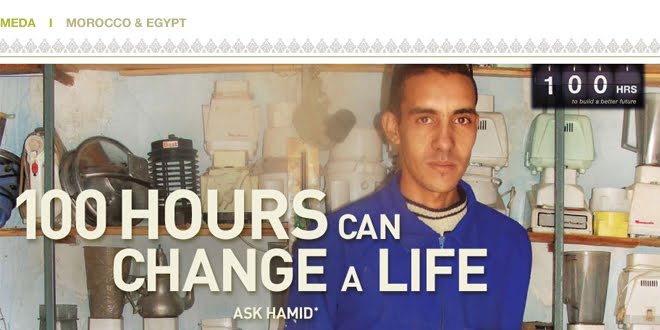
MEDA's 100 Hours to Change program provides new options for unemployed youth in Morocco by giving them practical tools to begin building a better future.
